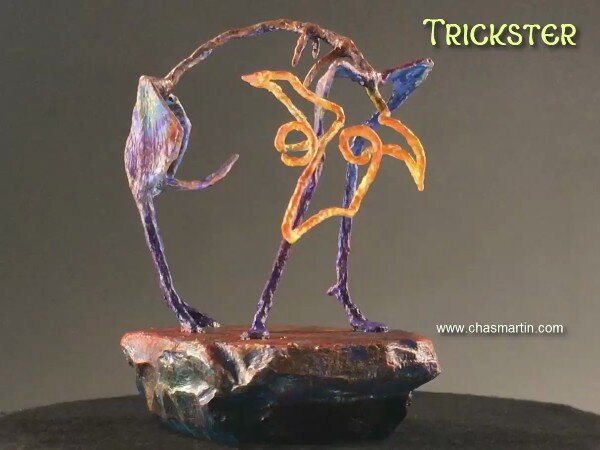
Trickster - Archetype of Challenge
The Trickster archetype is common to many cultures. It takes different forms, raven and coyote are the most common. Encounters with the trickster can be humbling, revealing and usually offer a learning opportunity. Regardless of the outcome. the encounters leave their message.
I do not focus on animal characters very often. I might have missed a lot of fun by overlooking them. This one began, as do most of my sculptures, as a series of graphite on paper sketches. See size and details.
Trickster is one of the new works included in my new book, “VOICES” which is available as a free ebook.

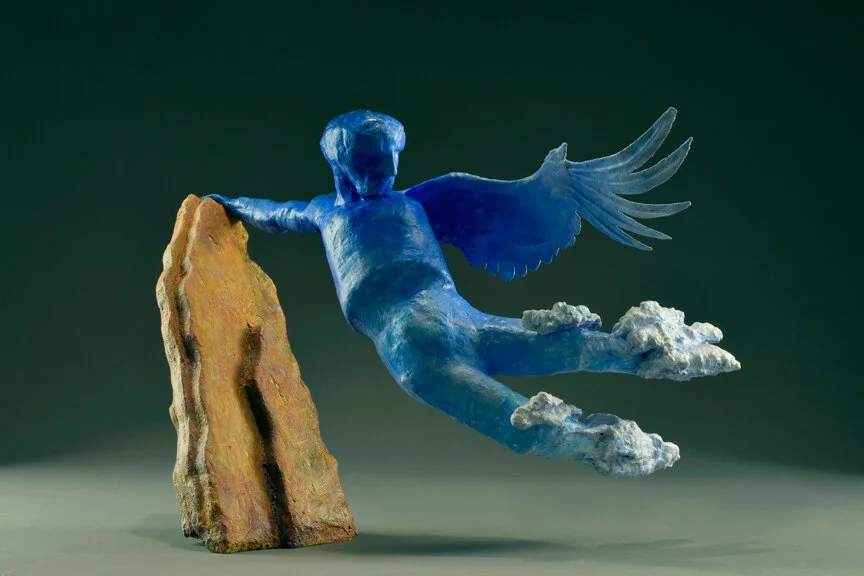
Man Turning into Sky
This piece was a challenge.Balance is the core of the form. I started with the rock and worked my way through the body to the clouds. It didn’t balance until I completed the legs. As with many of my pieces, transformation is an elemental theme. We are not static beings. As you cannot step into the same river twice, you cannot be the same person tomorrow.
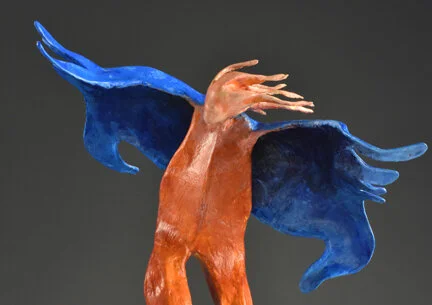
Seeing form in the void
Humans have a natural ability to see and recognize things. You see something. Your brain immediately matches the image to a pattern you’ve seen before. Recognition accomplished. Comprehension is complete. Congratulations. You’ve understood the object and completely missed the space, the invisible element of the image.

Positive and negative areas in 2-dimension cannot define form and void in space.
Space is only invisible until you see it. Once seen, it cannot be unseen. The void becomes a thing. It’s real. It’s tangible. It adds another level of comprehension to your experience of the object.
In this 2-dimensional example, the positive and negative spaces are flat. Aristotelian binary logic recognizes two options: white and non-white. Everything that is not positive is negative. There is form and non-form (aka space). That logic is fine if you’re trying to win an argument. In a 3-dimensional world, it’s a bit more complicated.
Think about the musical equivalent of this argument. There are notes and non-notes. All notes are part of the melody. Everything else is collectively defined as a “rest.” Imagine Beethoven’s 9th Symphony without the voids between notes. It would be a continuous stream of occasional repetitions with no punctuation, no cadence, no impact. The rest between notes provides valuable space to comprehend what you just heard, to anticipate what you will hear next and the opportunity to appreciate the uniqueness of the moment. You are engaged by the suspense. The frequency and duration of the rests are as important as the notes they separate. Many different notes create a melody. There are also many shapes and sizes to the voids.
Sculpture is a melody of form contained by spaces. The voids help you comprehend what you have seen, anticipate what you will see next and the opportunity to appreciate the uniqueness of the moment. Space itself is a form. It has as much shape and dimension as the sculpture it surrounds. And, like the sculpture, the space changes shape from each new viewing angle. This void creates an invisible series of forms - a progression of connected experiences that supports and illuminates the visible form. Your attention moves from one space to another in a continuous dance of interest, visual stimulation, a sequence of discoveries.
Shifting your focus to give space the same amount of consideration as the form is a challenge. I recently gave a student the following exercise to help open his eyes. First I had him create an abstract form in clay and place it inside a container. Then I had him fill the container with plaster. When that was cured, I instructed him to remove the clay and observe the plaster form that remained. Form and space were reversed. The plaster turned invisible space into a tangible form. Once seen, space cannot be unseen. For a sculptor, seeing space as a solid form is a revelation worth pursuing.
See “Fleeting Moment” details and price.

Space is a progressive, interactive, dynamic experience. It is a sequence of invisible forms guiding you around the tangible form. “Fleeting Moment”
The reward for asking questions
The wisdom found in a fortune cookie is usually amusing at best. However, I remember one fortune from decades ago that actually offered a valuable insight. The fortune read: “You never know until you try. Then you know.”
We are now experiencing changes that beckon us to try. Try anything. What’s the worst that can happen? If you try and fail, you just learned something.
That’s a victory.
I consider the truthful nature of this fortune often. You never know until you try. If you’re not trying something new or different, you aren’t really trying at all. You’re just following a pattern. Not a very creative approach for a sculptor or anyone else.
I spoke recently with Chayo Wilson, a fellow member of Pacific Northwest Sculptors. We talked about the things we do to center ourselves before going to our studios. Her studio is in her home. If you share that scenario, you know how difficult it can be to separate your work from your other work. Chayo’s solution is to go for a walk. Yes, she works at home and still, she walks to work. Brilliant! The simple act of taking a walk before entering her studio helps focus her attention on the work ahead.
In her ritualistic walk around the neighborhood, she always finds something. Or more accurately, something finds her: a feather, a small scrap of metal, a twisted branch, whatever. Each walk connects her with some object that centers her attention and sets the tone for what happens in the studio today.
Our conversation didn’t end there. We talked about members of our sculptors group and how different we are from each other. Whenever I get into a conversation with any of these people, something unpredictable usually happens. You never know what direction the conversation will take or what insight it may reveal. We’re such an eclectic group of spatially-oriented individuals, we all see things through completely different connotations and dimensions. A simple question can lead to a philosophical revelation, a suggestion for alternate materials, a connection to another artist, a comparison to another sculpture.
That unpredictability makes it worth the effort to seek out other artists and share your questions. That is, I believe, the true benefit being part of any artist group. There is always an insight waiting to be discovered. All you have to do is ask.
We are now being challenged daily to solve problems, both in the studio and life in general. Social distancing takes a toll on how we interact with people we know. It also makes it difficult to interact with people we don’t’ know. That is a real limitation. We have to stretch our connections and seek fresh input if we are to remain creative. I recall a line by Bob Dylan, “He not busy being born is busy dying.” Being born involves attention, effort and reward.
Here’s the challenge I offer. If you belong to a group of creative people, find someone whose work intrigues you. Introduce yourself and start a conversation. The odds of that being a welcome interchange are very high. You will accomplish several things. First, you’ve made a new connection. Second, you don’t know where that conversation will lead, but it will likely result in some new insight. Third, you have taken control over social distancing by safely eliminating the distance.
You never know until you try. Then you know!
Welcome to Chas Martin” Artist Journal — reflections on sculpture, creative process, imagination and studio practice.