Prize of Hope Award at Dell'Arte International
On Saturday, June 25, I participated in the award ceremony for this year’s Prize of Hope in Blue Lake, CA. The event was hosted by Dell’Arte International and Aasen Teater, the Danish Institute for Popular Theater in Brødholtvej, Denmark. The 2022 Prize of Hope was awarded to the Zimbabwe Theater Academy. The evening festivities included a performance of the 2-person play, “Zandezi,” created and performed by Cadrick Msongwlwa and Ronald Sigeca under the direction of Lloyd Nyikadzino.
It was my honor as the commissioned artist for this year’s award which has traditionally taken the form of a mask. My process began viewing videos of the performance, reading the script, researching Zimbabwean mask styles and then producing about 50 sketches. After sharing my concept with Dell’Arte CEO, Alyssa Hughlett, I shaped the original mask in clay, created a silicon mold and cast three masks which were then painted. One mask was awarded to the group from Zimbabwe, one went to Denmark and the third is now in the Dell’Arte International collection.
The play (also performed several months ago at the Portland Playhouse here in Portland) has been described as a provocative, daring, and mind-blowing physical theater piece that challenges the criminal justice system. Zandezi is Zimbabwean slang for “prison.” The play questions if prison is for a rehabilitation or a place where innocent people become hardcore criminals.
Dell’Arte Institute and the Danish Institute of Popular Theater both focus on physical theater, a genre of theatrical performance that encompasses storytelling primarily through physical movement. In Zimbabwe, where 14 languages are spoken, the language of motion connects all.
Dell’Arte has been offering the Prize of Hope with the Danish Institute of Popular Theater since 2008; past recipients include Universes (2018), Cornerstone Theater (2016), Tim Robbins & the Actor’s Gang (2008), and many more!
My connection to Dell’Arte came through Tony Fuemeller, a locally-based master mask maker, actor, puppeteer, director and instructor. Many thanks for the introduction!
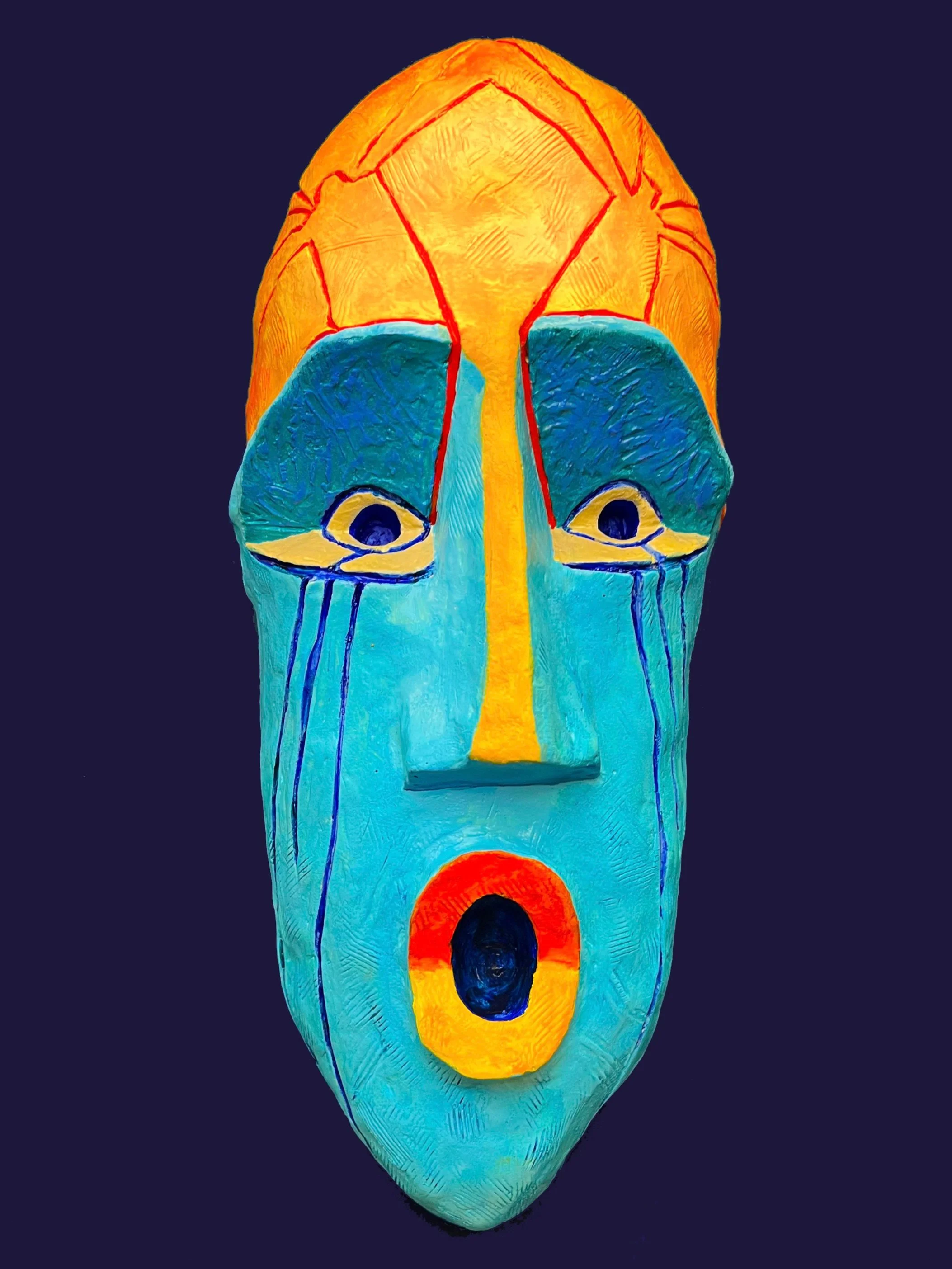

The mask was inspired in part by traditional mask styles of the Zimbabwean culture. The elongated facial shape vaguely suggests a shield. While we can see the story through the eyes of the mask, the shield protects us from experiencing it directly.
Deep lines in the face are evidence of stress, worry, fear and unknowing – all emotions experienced by Philani. They also suggest tears. Upon further discovery, these lines symbolize the two actors. Their interaction is the story.
The mask includes two additional figures in the forehead. These two figures celebrate the physicality of the performance. Their arms appear in multiple positions at once. The implied motion of their uplifted arms suggests hope and resurrection. The color implies sunrise, a new dawn, another world where hope is real, where rehabilitation is supported, where justice can be served.
Creativity is Perseverance

I started college intending to study psychology. I was fascinated with the mind, how it works, how it perceives surroundings, and how it creates. I quickly realized I was more interested in being creative than studying creativity. I changed my major to art. Now I do both.
One instructor I encountered at Pratt Institute was Emil Dispenza. Emil was a young, rising star among the art director community of New York City. He taught one class a week. I was in it. Emil was fearless, unabashed and wise. His philosophy: If there’s nothing interesting going in, there won’t be anything unique coming out. He demanded we absorb unrelated information constantly exposing ourselves to books, films, music, experiences that did not align with anything else we were doing. I went along with the challenge. I soon had banked all kinds of reference points for comparison. A pattern that applied in one area may trigger a solution in another, unconnected area.
For years, Edward DeBono was a leader in the processes of creative thinking. He perfected several techniques including Lateral Thinking to expand idea generation into new spaces. He encouraged exploration of impractical ideas as you journeyed from problem to solution.
These two men and their audacious approaches to creativity impacted my own approach for generating unique ideas. The first part of the process is to challenge the problem. Is this the real problem? Through critical analysis, it may not be. Or it may simply need to be restated to ignite a creative direction. The next part is to force your brain to identify 50 alternate solutions. The first dozen ideas are obvious. Automatic. Comfortable. The next dozen are off center, illogical or just weird. After that, you’re in the realm of impossible, impractical, unreasonable. That’s where real creativity begins.
In my first ad agency job in Boston, the head art director was a creative genius named Dick Wilkins. He taught me that you can temper an insane idea to get something workable. You cannot take a mediocre idea and make it great. He demonstrated this in meetings with clients. Dick was famous for presenting an idea to a client that was so outrageous, they were relieved when he then presented the tempered version he wanted them to approve. They usually did. Dick was another great inspiration and guide.
All my teachers and all my studies have led me to this conclusion. Creativity is a constant challenge. How you successfully solved a problem yesterday is not the process to solve a problem today. Every creative opportunity demands that you alter your steps, change pace, reverse your perspective, ignore logic and most importantly, value a wrong idea as legitimate steppingstone to a righter right. Judgement and creativity are competing processes. You do one or the other, never both at once.
Aristotle’s logic is the foundation for our education system. If something isn’t right, it’s wrong. Sorry, Aristotle, you get no points for creativity! Between the extremes of right and wrong is an infinite number of possibilities. This is the primordial soup of creative ideas where anything IS possible. It takes courage to challenge logic. But once you get the hang of it, it’s pure freedom. For years, as an art director and creative director, I was constantly selling the invisible to clients. My role was to imagine something never seen before and convince clients it was possible. I had to plant a visual in their imagination so they could also see beyond the obvious or anticipated to accept the unbelievable.
A unique idea is a visualization. To achieve realization, there are countless unforeseen obstacles and plenty of resistance. Perseverance is the path that turns visualization into realization – idea to reality. Perseverance is the path that rejects mediocrity and safety to achieve something truly memorable. Creativity is risky territory. Everything could go wrong. So what? You learn and grow from mistakes. You become more creative with every attempt.
Wisdom from a fortune cookie: You never know until you try…..then you know.
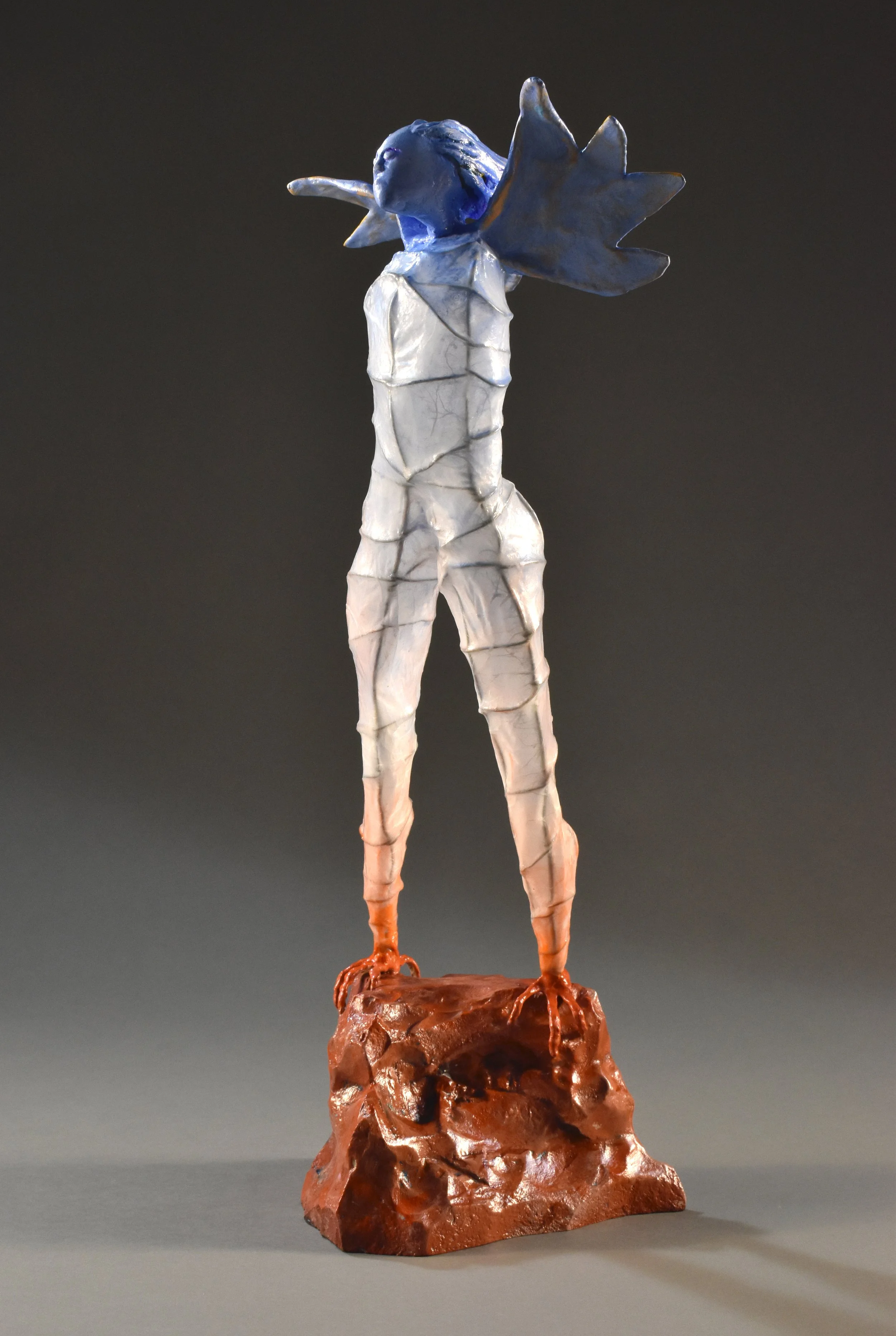
Leap
The act of springing free from the past, from the comfortable, from as if from the tangible into the unknown. That is the risk creative people take every day. That is the constant act of courage to create anything new.
It’s the act of passing from one state to another. Leaping into a new reality.
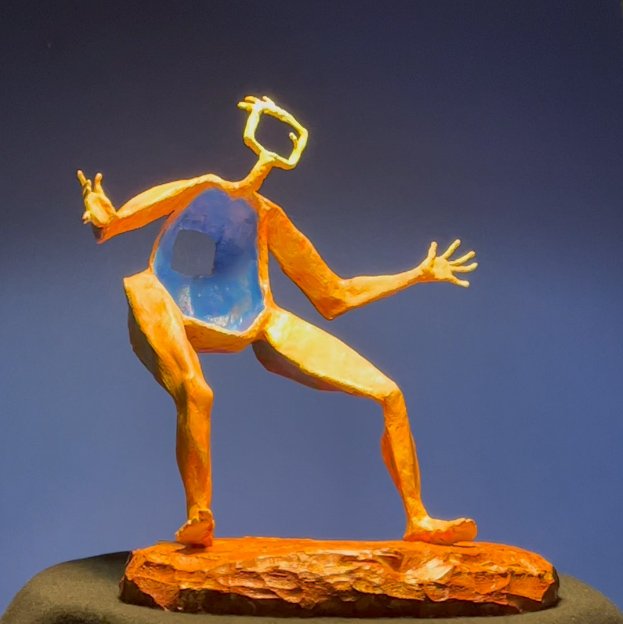
Revelation - When truth overcomes illusion
Among the many practices I find interesting is numerology. I was once told I am a number 8 - able to see both sides of the story, able to see balance, confident that patience will be rewarded.
My work explores illusion to discover the underlying truth. The archetype. The quality or experience that connects us rather than divides us.
“Revelation” is a statement about the realization of the truth. When disinformation or projected beliefs are eliminated, what’s left is that incredible “ah-ha” moment when everything is seen with fresh eyes.
Science historian, author, and television producer James Burke, in his series “The Day the Universe Changed” offered countless examples of how society’s view of the universe has been impacted by revelations. What we perceive as true is an illusion held together by current knowledge which can be overturned by scientific proof and/or direct experience. How the truth is revealed is not my point. When the veils of misinformation, political agendas, or any other form of illusion are pulled aside, what remains is undeniable. It can be unsettling, destabilizing and disruptive.
The truth shifts balance from what we once believed to what we now know.
Welcome to Chas Martin” Artist Journal — reflections on sculpture, creative process, imagination and studio practice.