The creativity of Lascaux
Cave paintings like those at Lascaux often conformed to the dimensional features of the cave walls. The artists took advantage of bulges and cracks of the irregular surfaces to create dynamic images. Deep inside the caves, a flickering fire was the only illumination. The movement of highlights and shadows produced an illusion of animation. The earliest artists understood multimedia.
As art “advanced” to more sophisticated techniques, cave walls gave way to cathedral walls and ceilings. Pigments and brushes evolved to offer artists broader choices. Wood panels became the substrate of choice, later replaced with stretched canvas or linen. There are many reasons for this transformation. Transportation of images may have been a primary driver for stretched fabric.
Somewhere along this evolutionary path, the viewing experience suffered a serious setback. Flickering storyboard images across an undulating cave wall created an interactive experience. The regularity of a flat, rectilinear canvas restricts the creativity of the artist. Our Flatland of perception isn’t limited to the canvas. Look at your phone or a TV screen. Flat images confined to a right-angled box limits your view and your imagination. Thinking “outside the box” suggests an extension of the X and Y axes. Bigger boxes or irregularly shaped boxes still severely limit your perception.

Cave paintings at Lascaux followed the contours of walls and ceilings enhancing the dimensionality of the figures.

Of course, not all artists subscribe to this limitation. Rene Magritte, Joan Miro and many others explored painting on 3-dimensional surfaces. The Y axis changes everything for artists and their art’s relationship to viewers. Moving from 2D to 3D changes how the brain perceives and expresses ideas. A painter tries to create an illusion of depth and space on a 2-dimensional surface. A sculptor works with real depth and space to create an experience that physically moves viewers in and around the multiple surfaces.
Creating sculpture is synonymous with creating interactive space. Engaging the viewers’ brain beyond the boundaries of a flat surface is an experience that literally has more dimension. The walls of Lascaux may be high relief instead of actual sculpture, but the masters who created those images understood the multidimensionality of perception.
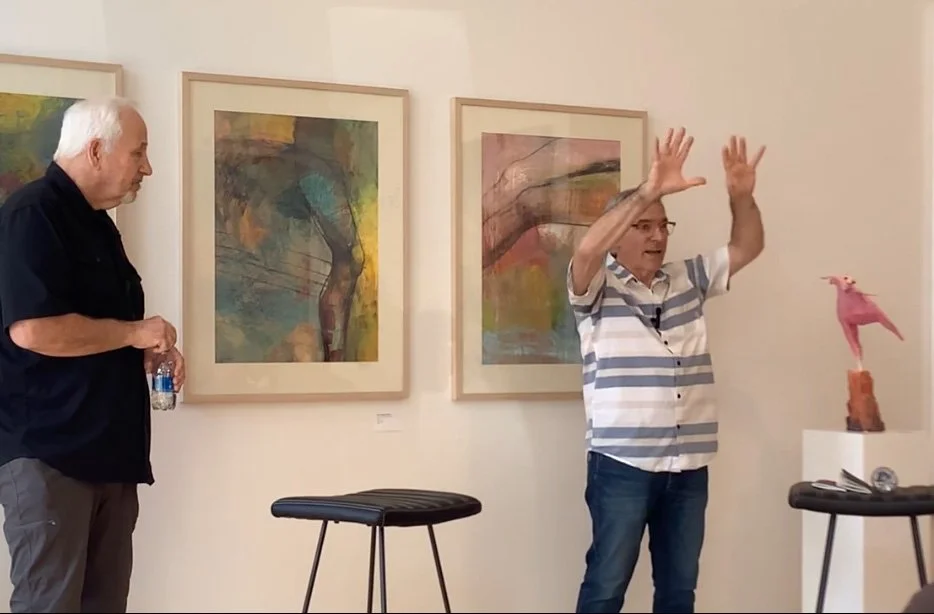
Artist Talk from “Notes for Travelers” show
This event was more like a conversation. Don Gray and I used this opportunity to share observations on our ideas, techniques and our relationship. Although we have different approaches, we share a similar palette and style of brushwork. Our September 2023 show at Art at the Cave in Vancouver, WA was a surprise for both of us when we saw how complimentary our pieces are. Thanks to Sharon Svec who curated this show and shot this video.
"Comfortably Numb" erases the boundaries between dimensions
Some pieces create themselves. When that flow begins, it’s an amazing experience. Most artists know this magical spot though it doesn’t happen often enough. At some point, you realize you are not creating, but acting as a conduit for the creation of a work of art. It’s thrilling, humbling, mystical, spiritual…

Comfortably Numb: 36”H x 42”W x 14”D - Sculpted figure mounted off the surface, casting a real shadow on the background.
“Comfortably Numb” was one of those pieces. From a couple of brief sketches, I saw the concept and its execution clearly. The figure took very little time to create. The gesture came together effortlessly. The canvas had to support the sculpture invisibly for the illusion to work. Even that was a short problem-to-solution step.
I did a rare thing at that point. I stopped working on the piece. I stepped back to enjoy what was happening. When a piece practically creates itself, the experience passes too quickly. The magic passes in a short, intense moment. With “Comfortably Numb,” I chose to enjoy the process completely. So, I set the canvas aside unpainted with the sculpture mounted to the surface. And I looked at it for a week or two.
Then, in a very short session, I blocked in the 2-color background. It was a simple wash of Manganese at the bottom and Pyrrole Orange across the top. It had a Rothko vibe. I left that alone and simply observed for another week or two. Thinking but not doing. One morning the rocks and clouds became. Gradually, through the next week, the reflection and refraction of light appeared. Effortlessly. The most playful part was enhancing, but not fully rendering a shadow cast onto the surface by the figure. Suggesting waves near the horizon, the illusion was complete.
I have studied the illusions created by Rene Magritte. The geometry of Comfortably Numb is spatially similar to several of Magritte’s 2- and 3-dimensional works. Equally important are his titles. Each image makes a statement. Each title offers a different perspective. Between the viewer, the art and title a question is forged. And you are engaged.

The title of this piece was illusive. On one level, it might be a pollution or climate change statement. On another, might be comment on our current media/political game show. It’s could be a dream sequence. Or a mirror.
While packing sculptures for “Notes for Travelers,” an exhibit at Art at the Cave in Vancouver, WA, it came to me. Comfortably Numb reflects our shared personal predicament. We are moving blindly through space. Maybe intentionally. Maybe not.
It’s hard to define where an idea begins. But the idea is just the beginning. View this 3-minute video for a concise explanation of what happens between the initial idea and the finished sculpture.
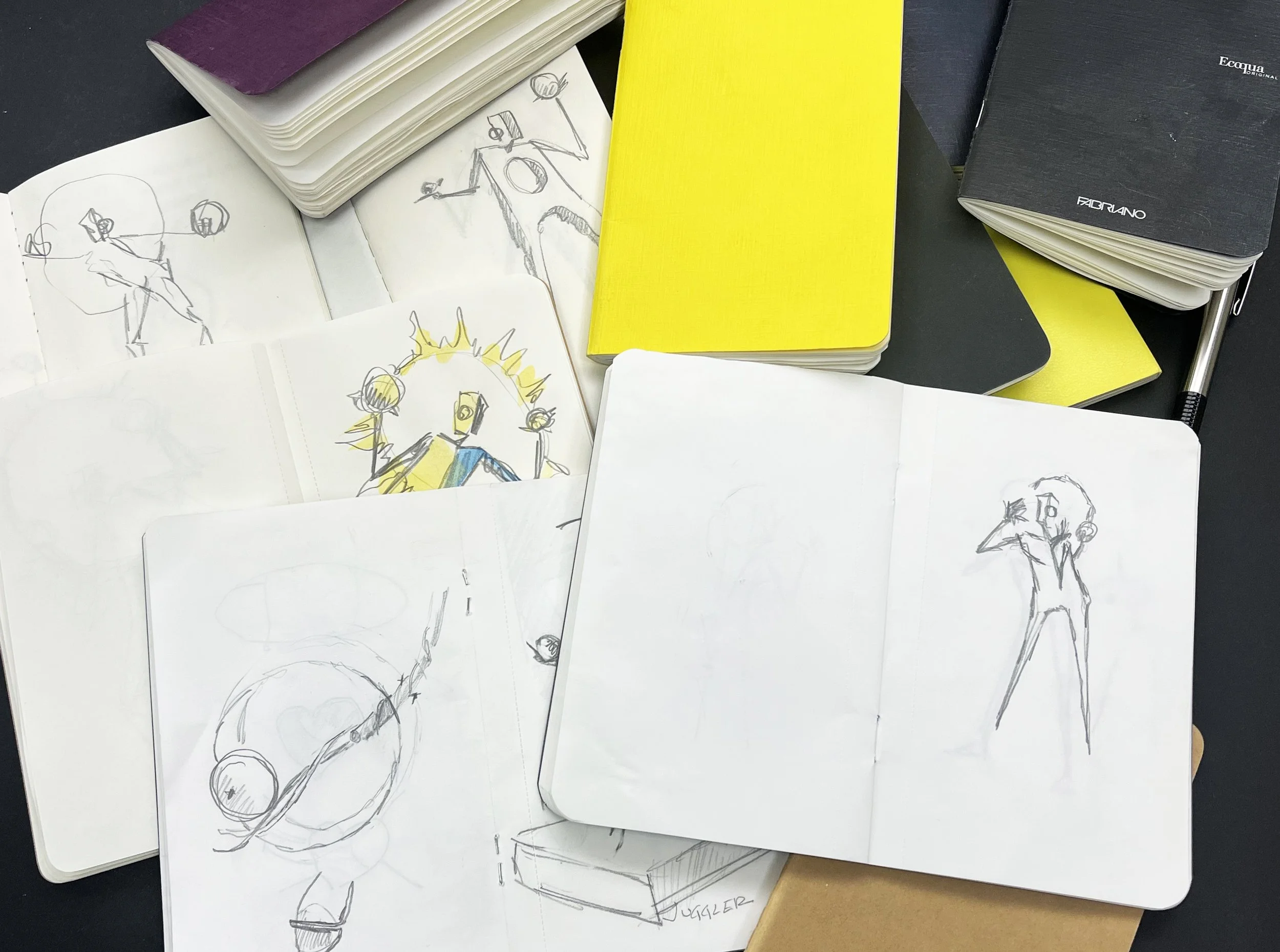
How ideas become sculpture
It’s hard to define where an idea begins. But the idea is just the beginning. This is a concise explanation of my creative process - what happens between the initial idea and the finished sculpture.
Welcome to Chas Martin” Artist Journal — reflections on sculpture, creative process, imagination and studio practice.