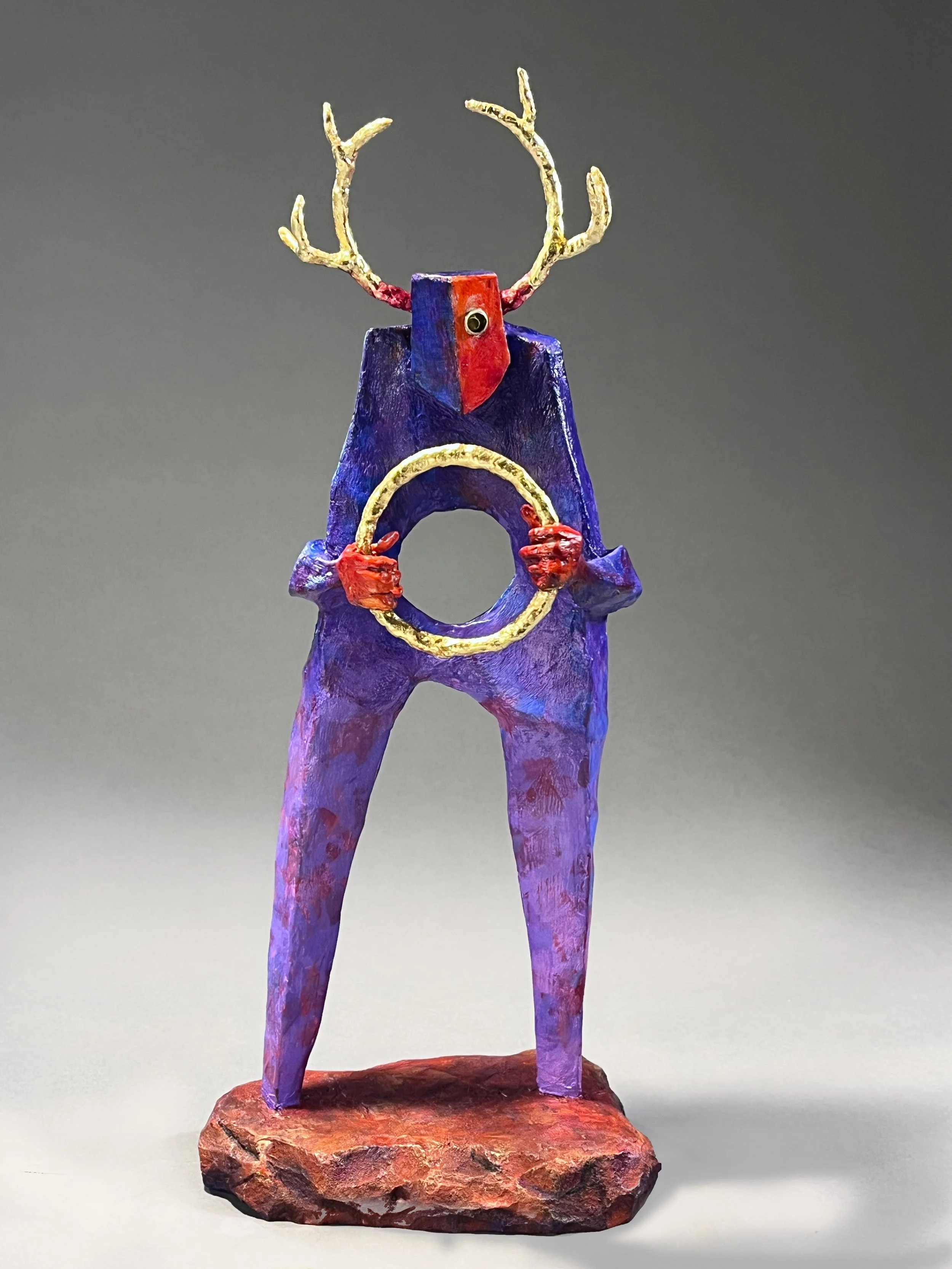
“Presumption” is an attitude dictated by past experience or probability. A presumption is a projection of what you expect to see. What you think can limit what you see.
I have been fascinated with the concept of perception since art school. A recent detour into quantum physics (physics lite, not the deep end) explains my fascination. At the quantum level, the act of observation changes the observed. The viewer is never separate from what is being viewed. That idea has never left me.
But there is more to it than physics.
The brain is a supreme pattern-matching machine. Neuroscientists call it predictive processing — the brain doesn't passively receive visual input, it actively predicts what it expects to see based on everything it already knows. New information gets matched to the nearest familiar pattern and filed away accordingly. Efficient, yes. But it means we rarely see what is in front of us. We are seeing our own mental library.
Perception, in that sense, is projection. We see what we expect to see. Our experiences, associations, and assumptions arrive before we do.
I watch this happen in real time when people encounter my abstract sculptures. There are distinct layers of how people perceive them. The first is often playful — my bright palette and dynamic forms are disarming. The second is intrigue. Each piece poses an unanswered question that resists quick interpretation, and the brain, denied its easy pattern match, keeps looking. The third layer touches something deeper. This is where the body responds before the mind catches up — a posture shift, an unconsciously mimicked gesture, a step back and crossed arms as something unexpected surfaces. The viewer is no longer seeing from intellect but from somewhere deeper. This is the Jungian archetypal level, where personal experience connects with universal patterns. The fourth layer is conversation. My pieces often prompt viewers to share what they have just felt — that moment of communication sparked by art reaches past the here and now to the timeless.
What I hear most often is this: "The more I look, the more meaning I see."
That is not coincidental. My unanswered questions are not a stylistic choice — they are a perceptual strategy. I am not trying to communicate a specific message. I am trying to slow the viewer down long enough for something genuine to rise from their own depths. The sculpture provides the threshold. The viewer brings everything else.
This is what makes art different from information. Information satisfies the pattern match process. Art interrupts it. It slips past the brain's predictive reflex and reaches something older and quieter. It speaks to what you have always known but rarely pause to consider.
The act of observation changes the observed. At the quantum level and in the gallery, it turns out, the same rules apply.