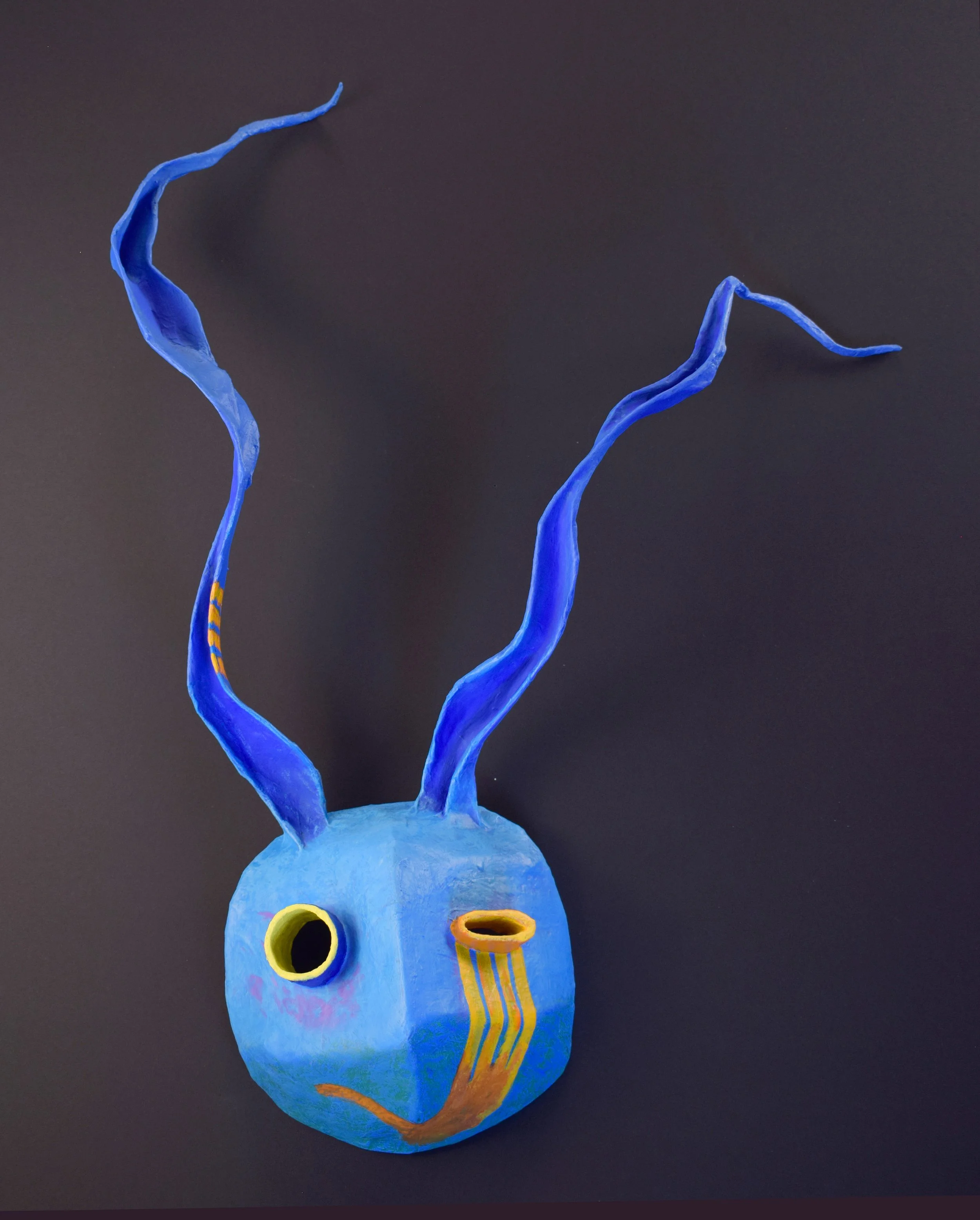
“Patience” was the first mask in an ongoing series.
It started with a sculpture I had just finished. I really liked the head, but it was only an inch and a half tall. So I made a life-size mask of that face. Bang! A personality was staring back at me.
That experience several years ago was the beginning of a new path that still intrigues me.
Masks are among the oldest human objects. Nearly every culture has created them — ritual, theater, ceremony, transformation. African masks channel ancestral power. Japanese Noh masks convey spiritual states. Greek theater masks that let a single actor embody tragedy and comedy, hero and villain. The variety is endless, but the underlying idea is the same. A mask allows something larger than the individual to speak. There’s always something to be discovered.
My masks are built from corrugated board, paper, wire, polymer, and acrylic paint — humble materials that somehow insist on becoming characters. I don't create these characters so much as find them in the process. As a mask develops, its voice gets louder and clearer. It is like telling and listening to a story at the same time.
The themes that I explore are Jungian at their core. The Shadow — that hidden other side of the personality that Jung identified as the part of ourselves we least acknowledge — appears frequently. So does transformation, made visible by treating both halves of the face differently. One eye open explores the external world. One eye closed focuses inward. A single face holding two truths simultaneously.
These are not decorative. They are archetypal characters — imaginative exaggerations of human qualities that live in all of us. They don’t hang passively on a wall. They watch and wait. They ask something of the person looking back.
That conversation, quiet and direct, is why masks fascinate me.