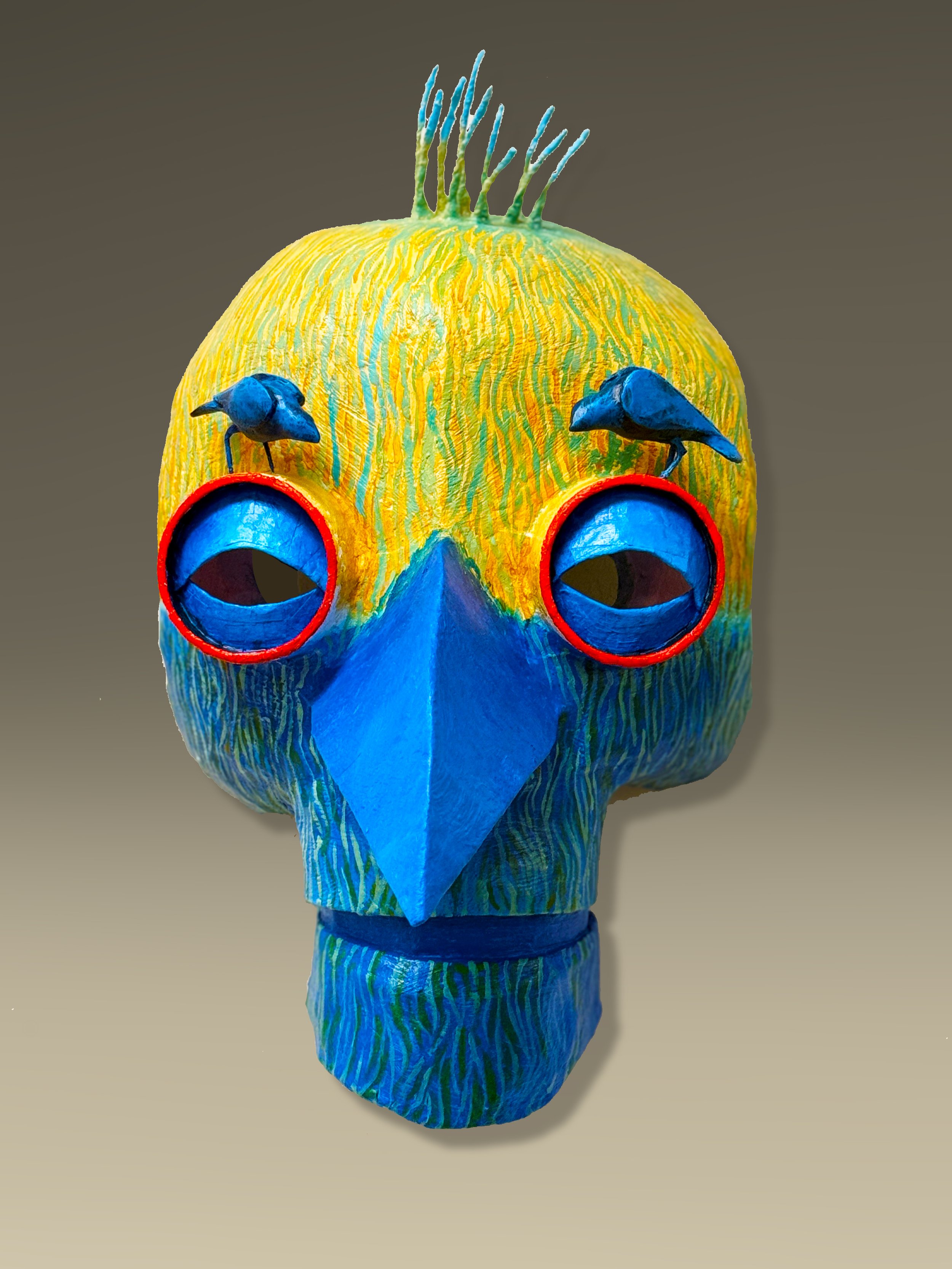
Birds Watching - 19x 12x 11”
Birds Watching is a mask with a bird's beak and two birds perched on its brows. The birds are the observers here. The mask is their perch.
Birds see what we do not. They were here long before us.They are living dinosaurs, the only branch of that lineage to survive. Our ancestors paid attention to them. At Lascaux, 17,000 years ago, one of the strangest images on the cave walls shows a bird-headed or masked man beside a bird on a stick. Its meaning is unknown, but birds were among the subjects of our earliest art. Older examples exist. Bird imagery in the cave at Chauvet in France is roughly 36,000 years old. Older examples exist in Indonesia.
Vultures appear at Göbekli Tepe, around 11,000 years ago. Egypt gave us Horus the falcon. In the Pacific Northwest, the raven is a central figure in masks, relief carvings, totem poles and paintings. Because birds inhabit the realm we cannot, they have been symbolized as messengers between earth and sky, the living and the dead, the human and the divine.
Crows live about 7 to 8 years in the wild and ravens 10 to 15. In captivity ravens have reached 40 or more. Some corvids make tools, and many solve problems and recognize individual people. A crow remembers a threatening human face for years and teaches its grudge to other crows, including young birds who never saw the original offense.
Birds see differently than we do. Many see four color channels, including ultraviolet, where we see three. Plumage and surfaces that look plain to us carry patterns for them.
They also see more of each moment. Many species have a higher flicker-fusion rate than humans, so fast movement that blurs for us stays resolved for them. Their eyes are on the sides of their heads creating a field of view approaching 360 degrees. Little escapes their notice.
The title Birds Watching is intended for more than one interpretation. We watch them. They watch us. But they have sharper eyes and longer memories.